Get a Free Estimate Today!
The Physics Behind Lifting Boxes Safely: A Comprehensive Guide
Moving boxes may seem straightforward, but improper lifting techniques are a leading cause of injuries during relocation.
Understanding the physics behind lifting boxes can help prevent strain, improve efficiency, and make your moving experience safer.
Understanding the Forces at Play
When lifting a box, your body acts like a system of levers and pulleys. The primary forces involved are:
- Gravity – The weight of the box exerts a downward force. Heavier boxes increase the risk of injury.
- Muscular Force – Your muscles generate an upward counterforce to lift the load. Improper alignment can overload your back muscles.
- Torque and Leverage – Holding a box far from your body increases torque on the spine, multiplying the effective weight.
For example, holding a 40-pound box 12 inches from your torso creates significantly more strain than holding it close to your chest.
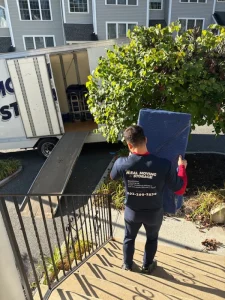
Studies by the National Institute for Occupational Safety and Health (NIOSH) confirm that keeping boxes near the body reduces spinal stress by over 30%.
Proper Lifting Techniques
- Bend Your Knees, Not Your Back
Squat down, keeping your back straight. Engage your legs instead of your lower back. This simple adjustment can prevent common lifting injuries. - Keep the Box Close to Your Body
Reducing the distance from your torso minimizes torque and protects your spine. - Avoid Twisting
Rotate your feet instead of your torso. Twisting while lifting increases shear forces on your spine. - Use Handles or Grip Points
Gripping the box at designated handles distributes weight evenly and reduces hand fatigue. - Team Lifting for Heavy Loads
For boxes over 50 pounds, lift with a partner or use equipment like dollies and straps. Even movers and packers in Fairfield CT rely on these techniques daily.
Real-World Examples
Case Study 1: Residential Movers
A Connecticut moving company reviewed one year of employee injuries. Workers who lifted without bending their knees experienced 40% more back strains than those trained in proper techniques. After implementing a lifting safety program, injury rates dropped 60%.
Case Study 2: Long-Distance Moves
During long distance moving from New York to Florida, movers carry multiple heavy items including appliances and furniture. Proper lifting mechanics prevent injuries, ensure boxes and furniture are not damaged, and improve efficiency.
Chronic poor lifting over such long distances can lead to long-term back problems.
Tools That Make Lifting Safer
- Dollies and hand trucks: Convert vertical lifting into rolling motion to reduce strain.
- Straps and harnesses: Distribute weight evenly across stronger muscle groups.
- Ergonomic gloves: Improve grip and prevent slips, especially for awkwardly shaped boxes.
- Back support braces: Provide additional stability for heavier loads.
Even professional movers use these tools routinely to protect their team and ensure smooth operations.
Common Mistakes to Avoid
- Lifting with a bent back while straightening legs.
- Carrying boxes too far from the torso.
- Ignoring fatigue — tired muscles are more prone to injury.
- Avoiding equipment — dollies and straps are lifesavers for heavy or bulky items.
How Real Moving & Storage Helps?
While understanding physics and using proper lifting techniques is essential, professional moving companies like Real Moving & Storage take safety a step further.
Their teams are trained in ergonomic lifting, use specialized equipment for heavy and delicate items, and have years of experience handling long distance moving from New York to Florida.
They also guide families on packing and unpacking efficiently, reducing stress and preventing injuries.
By combining training, experience, and the right tools, Real Moving & Storage ensures that your belongings arrive safely while keeping your family and movers protected.
Key Takeaways
Safe lifting is more than a habit — it’s physics in action. By understanding forces, torque, and body mechanics, anyone can move boxes with minimal risk. Remember: use your legs, keep items close, avoid twisting, and don’t underestimate the value of professional help.