Get a Free Estimate Today!
Warehouse Staging Strategies for Large Relocations
Relocating a warehouse is far more complex than moving inventory from one building to another. Businesses must coordinate inventory, equipment, personnel, transportation, technology systems, and customer fulfillment operations—all while minimizing disruptions.
One of the biggest factors that determines whether a warehouse move succeeds or fails is staging.
Warehouse staging creates an organized transition process that helps businesses maintain inventory visibility, improve loading efficiency, reduce errors, and accelerate operational recovery after relocation.
Without a staging strategy, warehouse relocations often suffer from inventory confusion, shipment delays, misplaced products, extended downtime, and increased costs.
This guide explains the most effective warehouse staging strategies for large relocations and how businesses can use them to achieve a smoother move.
At Real Moving & Storage, we’ve seen how proper staging can dramatically improve relocation outcomes for businesses moving warehouses, distribution centers, and commercial facilities.
What Is Warehouse Staging During Relocation?
Warehouse staging is the process of organizing inventory, equipment, and assets into designated holding and preparation areas before transportation begins.
Instead of moving items randomly, staging creates a structured workflow that allows relocation teams to:
- Track inventory accurately
- Prioritize shipments
- Improve loading efficiency
- Reduce handling errors
- Speed up unloading
- Support business continuity
Think of warehouse staging as the bridge between inventory management and transportation logistics.
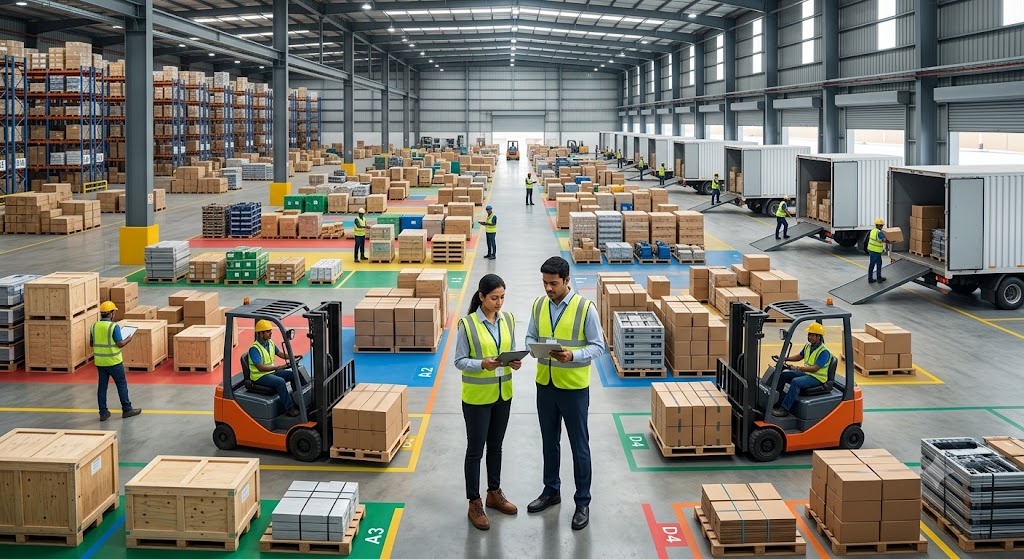
Why Staging Is Critical for Large Warehouse Relocations
Large warehouse moves often involve thousands of products, multiple departments, specialized equipment, and strict timelines.
Without proper staging, businesses may experience:
- Inventory discrepancies
- Shipping delays
- Lost products
- Increased labor costs
- Extended downtime
- Customer service disruptions
Staging creates order before relocation begins, reducing uncertainty and improving operational control throughout the project.
Start With a Complete Inventory Audit
The foundation of every staging strategy is inventory visibility.
Before any assets are moved, businesses should conduct a detailed inventory audit.
This process helps identify:
- Current inventory levels
- Obsolete products
- High-priority inventory
- Slow-moving stock
- Damaged items
- Special handling requirements
Many businesses discover opportunities to reduce transportation costs simply by eliminating unnecessary inventory before relocation begins.
Create Dedicated Staging Zones
One of the most effective warehouse staging strategies is creating clearly defined staging areas.
These zones help separate inventory based on relocation priorities.
Common staging categories include:
- Immediate operational inventory
- High-priority shipments
- Equipment and machinery
- Archived inventory
- Fragile products
- Department-specific assets
Proper staging zones improve organization and make loading operations significantly more efficient.
Use Inventory Labeling and Tracking Systems
Inventory control becomes increasingly important as relocation complexity grows.
Every pallet, shelf, carton, and asset should be clearly labeled before entering staging areas.
Many businesses use:
- Barcode systems
- QR code tracking
- Color-coded labels
- Digital inventory software
- Asset management platforms
Accurate labeling reduces confusion and improves inventory visibility throughout the move.
Prioritize Inventory Based on Operational Needs
Not all inventory has the same level of importance.
A common mistake businesses make is treating every asset equally during relocation.
Instead, inventory should be categorized based on:
- Order frequency
- Revenue contribution
- Customer demand
- Storage requirements
- Operational necessity
High-demand inventory should typically be relocated first so fulfillment operations can resume quickly at the new location.
Implement a Phased Relocation Strategy
Many successful warehouse relocations use phased moving rather than a complete shutdown.
A phased approach allows businesses to:
- Continue serving customers
- Reduce operational downtime
- Identify issues early
- Maintain inventory control
- Reduce relocation risks
Inventory staging plays a critical role in supporting phased relocation strategies.
Businesses utilizing Commercial Moving Services in Westport CT often implement phased moving schedules to maintain business continuity throughout the relocation process.
Coordinate Transportation With Staging Operations
Warehouse staging and transportation planning must work together.
Transportation schedules should align with staging priorities to prevent bottlenecks.
Effective coordination includes:
- Truck scheduling
- Loading sequences
- Inventory verification
- Route planning
- Delivery scheduling
When staging and transportation teams communicate effectively, relocation efficiency improves dramatically.
Prepare Equipment and Machinery Separately
Warehouse relocations often involve more than inventory.
Equipment such as:
- Forklifts
- Conveyor systems
- Pallet racking
- Packing stations
- Scanning systems
requires dedicated staging plans.
Businesses should stage equipment separately from inventory to simplify transportation and installation.
Use Professional Packing for Sensitive Inventory
Large relocations frequently involve products that require specialized handling.
Examples include:
- Electronics
- Medical supplies
- Fragile inventory
- Temperature-sensitive products
- High-value assets
Professional packing reduces damage risk and improves inventory protection during staging and transportation.
Companies utilizing Packing and Unpacking Services in Norwalk CT often experience improved inventory protection and faster relocation execution.
Support Business Continuity Through Strategic Staging
The primary objective of warehouse staging is not simply organization—it is operational continuity.
Effective staging allows businesses to:
- Maintain customer service
- Reduce fulfillment interruptions
- Protect inventory accuracy
- Resume operations faster
- Reduce revenue loss
Companies that prioritize staging often recover from relocation projects significantly faster than those that do not.
Warehouse Staging for Long-Distance Relocations
Long-distance warehouse moves introduce additional logistical challenges.
Inventory may remain in transit longer and transportation coordination becomes more complex.
Businesses working with a Long Distance Moving Company in Fairfield CT often rely on advanced staging procedures to maintain inventory visibility throughout extended transportation schedules.
Similarly, organizations planning Long Distance Moving from Connecticut to South Carolina frequently use warehouse staging to support inventory control across multiple transportation phases.
Common Warehouse Staging Mistakes
Many relocation challenges occur because staging is treated as an afterthought.
Common mistakes include:
- Skipping inventory audits
- Poor labeling systems
- Mixing inventory categories
- Lack of transportation coordination
- Inadequate employee training
- Failure to prioritize inventory
Avoiding these mistakes can significantly improve relocation efficiency.
Warehouse Relocation Staging Checklist
Before beginning a warehouse move, verify that you have:
- Completed an inventory audit
- Created staging zones
- Implemented labeling systems
- Prioritized inventory categories
- Coordinated transportation schedules
- Prepared equipment relocation plans
- Developed contingency procedures
- Assigned staging responsibilities
This checklist helps create a more controlled and efficient relocation process.
How Real Moving & Storage Supports Warehouse Relocations
At Real Moving & Storage, we understand that warehouse relocations require detailed planning, inventory control, and operational coordination. Our team helps businesses create organized staging strategies that support efficient transportation, inventory protection, and business continuity.
Since 2006, our family-owned company has provided reliable commercial moving solutions throughout Connecticut and beyond. Founded by Lucas Pinto, who brings more than 25 years of moving industry experience, we remain committed to helping businesses execute complex relocations with confidence.
Frequently Asked Questions
What is warehouse staging during relocation?
Warehouse staging is the process of organizing inventory and assets into designated preparation areas before transportation begins.
Why is warehouse staging important?
Staging improves inventory control, loading efficiency, transportation coordination, and operational continuity during relocation.
How do businesses reduce downtime during warehouse relocation?
Strategies such as phased moving, inventory prioritization, staging zones, and transportation coordination help minimize downtime.
What should be included in a warehouse staging plan?
A staging plan should include inventory audits, labeling systems, staging zones, transportation schedules, equipment planning, and contingency procedures.
Can warehouse staging improve inventory accuracy?
Yes. Proper staging significantly improves inventory visibility, tracking, and accountability throughout the relocation process.